Pro Tips
Manager Effectiveness KPIs: What to Actually Measure in a Hybrid Team
The case for measuring manager effectiveness is not difficult to make. Employees with ineffective managers are significantly more likely to underperform, disengage, and leave. If there is a single lever in the people function with that kind of downstream impact on retention, productivity, and business performance, measuring it precisely — and measuring it in time to act — should be a priority.
The harder question is what to measure. Most organisations have an answer to this. It usually involves engagement scores, upward feedback surveys, and team retention rates. These are not wrong. They are simply too late.
The Problem With Most Manager KPIs
The conventional set of manager effectiveness metrics shares a structural flaw: they are retrospective. They tell you how a manager performed over a period that has already ended, in conditions that may have already changed.
An engagement survey score reflects how a team felt in the weeks before the survey was administered — which could be six months ago. A retention rate tells you that people left, not that they were at risk of leaving. Upward feedback, collected annually or semi-annually, describes a manager's behaviour through the lens of a team member's memory, filtered through whatever social dynamics existed in that team at the time.
Research consistently shows that the majority of managers in distributed environments are not rated as highly effective. That number suggests the measurement problem is real — but it also suggests that organisations are finding out their managers are struggling after the fact, not in time to do something about it.
In a co-located environment, informal feedback loops partially compensate for this lag. A senior leader can observe a manager's team in a meeting, pick up on tension, notice that someone has gone quiet. These low-fidelity signals are imperfect but they operate in real time.
In a hybrid team, those signals disappear. What remains are the formal metrics — and if those metrics are lagging indicators, the gap between reality and what leadership can actually see grows considerably.
What Manager Effectiveness KPIs Should Actually Measure
Measuring manager effectiveness well means separating two things that are often conflated: outputs and conditions.
Outputs are the metrics most organisations already track — team performance against targets, project delivery, retention rates, engagement scores. These matter. They are not sufficient on their own.
Conditions are what determine outputs before they become visible — the state of the team under a manager's leadership at any given point. The workload distribution. The quality of communication. Whether the team has the psychological safety to raise problems before they become escalations. Whether the manager themselves is operating under sustainable pressure or accumulating load that has not yet broken the surface.
An effective manager KPI framework tracks both. The output metrics provide accountability and longitudinal benchmarking. The condition metrics provide the early visibility that allows intervention before the output metrics deteriorate.
The Manager Effectiveness KPIs Worth Tracking
Team retention rate — by manager, not by department
Retention is the most commonly cited manager effectiveness metric, and with good reason. But the aggregation matters. A department-level retention figure can mask the fact that attrition is concentrated under one or two specific managers while others are performing well.
Tracking retention at manager level, over rolling six and twelve month windows, surfaces these patterns. It also changes the conversation — from "we have a retention problem" to "we have a manager effectiveness problem in specific teams," which is a considerably more solvable problem.
The limitation is that retention is a pure lagging indicator. By the time it moves, the cost has already been incurred.
Upward feedback scores — with meaningful cadence
Upward feedback — structured assessment of a manager by their direct reports — is one of the more reliable proxies for manager effectiveness available to HR teams. It correlates meaningfully with team performance and retention outcomes when done well.
The critical variable is cadence. Annual upward feedback is nearly useless as an operational metric. It arrives too infrequently to detect change, and the gap between collection and action is too long to influence anything in real time. Quarterly is better. A lightweight rolling process is better still.
The other variable is what the questions are actually measuring. Generic satisfaction ratings produce generic averages. Questions focused on specific manager behaviours — whether the manager provides clarity on priorities, whether they create conditions where the team can raise concerns, whether direct reports feel their workload is sustainable — produce data that is actionable.
Team health signal consistency
One of the most underused indicators of manager effectiveness is the consistency of a team's health signals over time, rather than their absolute level.
A team with an engagement score of 7.2 that has been declining for three consecutive months is a more urgent signal than a team sitting at 6.8 that has been stable. Trajectory is more informative than snapshot, and most KPI frameworks are built around snapshots.
Tracking the direction of team health metrics under each manager — communication patterns, collaboration intensity, response times, meeting participation — provides a leading view of where problems are developing before they manifest in attrition or performance decline.
Manager workload and overload indicators
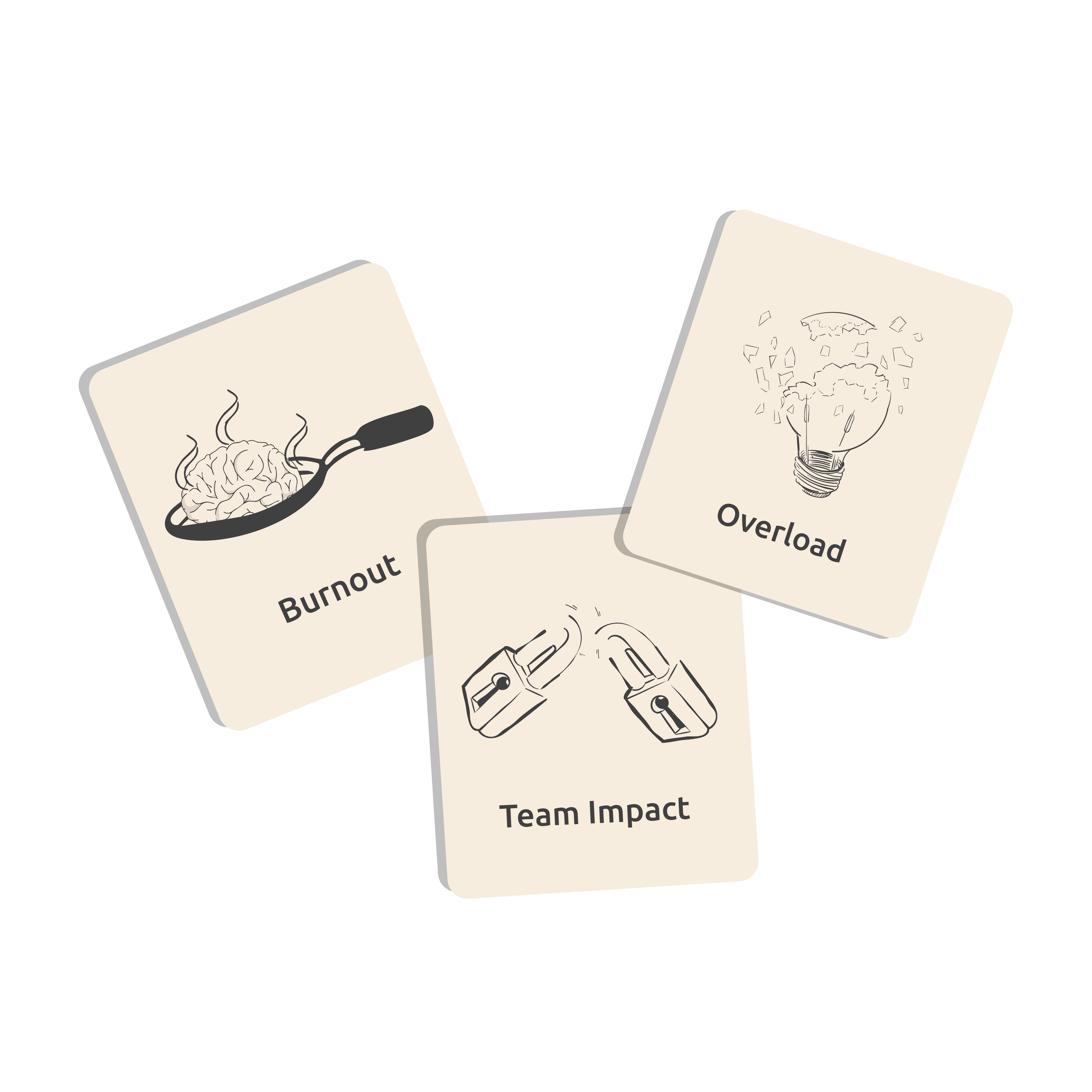
A significant proportion of managers report being at risk of burnout due to increased responsibilities and stretched resources. This is not a minor footnote — it is one of the most significant and least measured risks in most people functions.
A manager operating under unsustainable load is not simply at personal risk. They are a risk to the team beneath them. Overloaded managers communicate less clearly. They miss early signals from their direct reports. They defer difficult conversations. They stop doing the proactive coaching that distinguishes effective management from adequate management.
Measuring manager workload directly — span of control, meeting load, response patterns, project complexity — gives HR and senior leadership a view into where managers are approaching their limits before the consequences cascade through the team.
Direct report performance distribution
A well-functioning team under an effective manager tends to show relatively distributed performance — most people contributing, most people developing. A team with performance heavily concentrated in one or two individuals while others are static or declining is often a signal of ineffective management rather than individual underperformance.
This metric requires correlating individual performance data with manager data, which not every organisation is set up to do. But where the data exists, it is one of the more sensitive leading indicators of management quality available.
The KPI That Most Organisations Are Missing
The gap in most manager effectiveness frameworks is not a missing metric. It is a missing question.
Most frameworks measure whether a manager is currently performing well. The more important question, for a hybrid organisation under growth pressure, is whether a manager is accumulating conditions that will produce poor performance in the near future.
Burnout does not announce itself. Attrition does not announce itself. The manager who is three months from losing two key people and falling behind on delivery looks, from the outside, like a manager who is coping. The signals are there — in the team's communication patterns, in the manager's own behaviour, in the subtle changes that precede visible deterioration. They are just not being read.
Teams with structured hybrid collaboration frameworks are substantially more likely to be engaged and less likely to burn out — but that structure is only valuable if leaders have visibility into whether it is holding or beginning to fray.
Building a Framework That Works in Practice
A practical manager effectiveness KPI framework does not need to be comprehensive. It needs to answer three questions:
Is this manager's team currently healthy? Answered by condition metrics — team climate, communication patterns, workload signals — tracked continuously rather than periodically.
Is this manager's team trending in the right direction? Answered by trajectory data — whether condition metrics are improving, stable, or deteriorating over the past 30, 60, and 90 days.
Where do we need to act before this becomes a problem? Answered by flagging mechanisms that surface early signals to HR and senior leadership before they require intervention rather than prevention.
The organisations getting this right in hybrid environments are the ones that have moved beyond measuring manager effectiveness once a year and started treating it as an ongoing operational signal — something read in real time, not reconstructed after the fact.
The difference between those two approaches is not one of effort. It is one of timing. And in a scaling organisation, timing is frequently the difference between a problem that gets solved and a problem that becomes expensive.

More Insights
Manager Effectiveness KPIs: What to Actually Measure in a Hybrid Team
Pro Tips
Read Blog

Why Your Annual Engagement Survey Is Failing
Basics
Read Blog

Manager Impact on Employee Retention
Pro Tips
Read Blog

Why Surveys Fail to Stop Burnout
Team Health
Read Blog

How to Implement People Analytics Without “Big Brother” Vibes
Pro Tips
Read Blog

The Lagging Indicator Problem: Why Surveys Fail to Stop Burnout
Pro Tips
Read Blog
The SPACE Framework Explained: An Engineering Leader’s Guide to Team Health
Team Health
Read Blog

Using Predictive Signals to Identify Quiet Quitting Before the Attrition Spike
Team Health
Read Blog

Top 5 Manager Blind Spots in Remote Team Management
Pro Tips
Read Blog

A New Framework for Manager Effectiveness in 2026
Team Health
Read Blog
Why the 6-Month Feedback Loop is Killing Your Hybrid Culture
Team Health
Basics
Read Blog
Book A Demo